From a Chaotic Square to a Functional Hub: Reimagining Mobility Around Florence's Santa Maria Novella
Replication & Deployment Programme
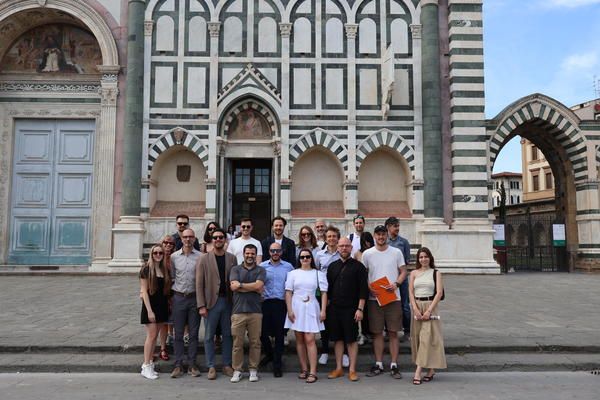
Image by Javier Bujeda / ICLEI Europe
How can one of the city’s busiest arrival hubs become safer, clearer and more liveable?
This was the central question explored during the three-day CIVITAS Study Visit in Florence, held from 16-18 June as part of the CIVITAS Replication and Deployment Programme. Bringing together city representatives from Łódź, EMT Madrid, Lviv and Osmangazi, mobility experts, and universities from across Europe, the visit focused on transforming the area around Santa Maria Novella train station from a congested and chaotic interchange into a more functional and accessible mobility hub that focuses on the people.
A strategic area under pressure
Florence is a compact city with mobility pressures that extend far beyond its local population. As the capital of Tuscany, a major rail interchange and one of Europe's most visited destinations, the city welcomed 4.3 million visitors and recorded more than 11 million overnight stays in 2025. Despite being around three and a half times smaller than Brussels, it must manage the daily mobility needs of commuters, residents and tourists within a dense urban area. The Santa Maria Novella area reflects this complexity. Around the station, pedestrians, cyclists, trams, buses, taxis, private vehicles, tourists and logistics activities all compete for space. For many visitors, it is also their first impression of Florence.
The city’s challenge, presented under the title “From a chaotic square to a functional hub”, is therefore not only about improving the movements to and from the train station, but also about creating a welcoming and accessible public space.
Understanding the challenge
The visit began with presentations from the City of Florence on its sustainable mobility strategy and ongoing projects, such as the EU-funded GOLIA or UNCHAIN, including public transport improvements, intermodal hubs, traffic management measures, digital mobility tools and incentivisation for cycling. Participants then visited the Santa Maria Novella area to observe the challenge first-hand.
The site visit highlighted unclear pedestrian routes, pressure around crossings, physical barriers around tram stops, limited accessibility in some areas, and the need for better signage and information.
It also showed that the challenge is connected to governance. Improving the station area requires coordination between many actors, such as municipal departments, transport operators, station managers and bike-sharing companies.
Learning from peers and experts
A key aim of the CIVITAS Replication and Deployment Programme is to help cities address real-life urban mobility challenges by learning from peers and experts.
In Florence, participants heard from the Ukrainian peer city Lviv, which shared its experience of mobility planning in a complicated context, and how they work on accessibility (which is becoming an ever-growing need) and intermodal hubs. Osmangazi Municipality presented its “Walk-in History” challenge, focused on creating better walking and multimodal connections and urban space in the heart of the UNESCO area.
Champion cities and external experts complemented these discussions by sharing practical examples, including experiences from Łódź and Madrid, as well as expert input from the VUB on the SmartHub mobility hub integration ladder and from the Start-up Marker on cycling visibility, wayfinding and digital mapping. One clear message emerged: infrastructure alone is not enough. People also need to understand how to use the space through clear information, intuitive design and effective wayfinding. The exchange also demonstrated the value of peer learning, with participating cities sharing practical experiences and identifying solutions that could be adapted to their own local contexts.
From diagnosis to action
During the workshops, participants worked in small groups to analyse the problem and develop possible solutions. Some of the ideas included improving pedestrian crossings and access to underground routes, reducing the dominance of taxi areas, reallocating spaces for pedestrians’ active mobility and better managing parking and kiss and ride areas.
Micromobility also emerged as a promising area for action. Participants discussed creating a micromobility and tourist information hub in Piazza dell’Unità, supported by new bike-sharing services around the station. This could help organise shared mobility more effectively while providing clearer information for tourists and other occasional visitors.
The final day focused on turning ideas into a more concrete action pathway. Through stakeholder mapping and implementation planning, participants explored how Florence could move forward: engaging stakeholders, gathering input from users, refining the solution and designing temporary tests, before moving towards permanent measures.
While developed in response to Florence's specific context, many of the approaches discussed - from improving way-finding to testing temporary interventions and strengthening stakeholder coordination - offer ideas that can be adapted by other cities facing similar mobility challenges.
Reflecting on the exchange, Eng. Filippo Martinelli from the City of Florence said: “For us, it was a great chance to have representatives from universities, municipalities and private companies working around the same table on our challenge. It was important to bring these perspectives together, point out the different situations and give us new ideas.”
By bringing different perspectives around the same table, the CIVITAS Programme helped Florence take an important step towards reimagining Santa Maria Novella not as a chaotic square, but as a functional, inclusive and sustainable mobility hub.
By bringing together cities, researchers and mobility practitioners, the CIVITAS Replication and Deployment Programme enabled Florence to test ideas, learn from peers and identify practical next steps. The study visit demonstrated how collaborative learning can help cities transform complex transport interchanges into more inclusive, sustainable and user-friendly mobility hubs. In this way, Florence took steps towards reimagining Santa Maria Novella, not as a chaotic square, but as a functional, inclusive and sustainable mobility hub.
View the photos from the CIVITAS Study Visit in Florence.
Author: Javier Bujeda