Fully automated robot bus in Tampere’s public transport system
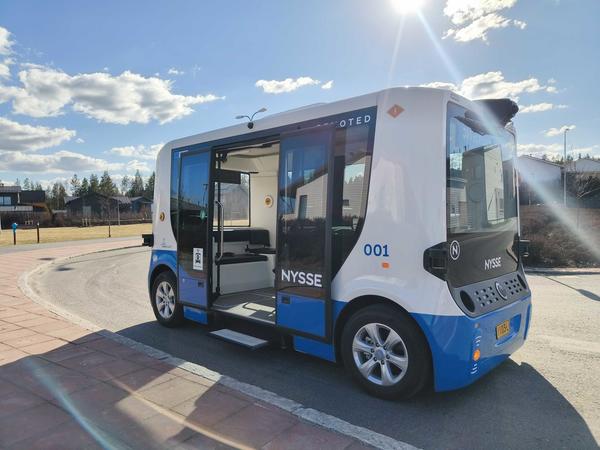
Image by Lisa Marie Hanß
On 24 June 2026, robot bus services operating on line 301 between Hervantajärvi and Lintuhytti in Tampere, Finland will transition to fully autonomous operations, without a safety driver on board. This marks a new phase in Tampere’s contribution to the metaCCAZE project, with an automated bus now operating as part of a commercially implemented public transport system while being continuously monitored remotely.
From testing to real-world deployment
Automated bus services have been tested in various locations worldwide, typically in controlled environments or pilot settings. In Tampere, however, the service is integrated into the city’s regular public transport network, allowing passengers to experience automated mobility in everyday conditions.
Since November 2025, the robot bus has been operating in real traffic with a safety driver on board. The transition to fully autonomous operation follows extensive testing, demonstrating that the service can operate safely without a driver inside the vehicle.
How the automated system operates
The robot bus operates along a predefined route at low speed, continuously observing its surroundings through onboard sensors. The system is designed to react immediately to its environment: when detecting obstacles or abnormal situations, it can stop automatically and safely.
Although no driver is physically present on board, the service is monitored in real time by professionals at a remote monitoring centre. Operators can intervene if necessary, ensuring an additional layer of safety and control.
Passenger experience and safety measures
For passengers, travelling on the automated bus remains similar to a regular journey, with tickets validated at the machine next to the door on each trip. At the same time, specific safety measures are in place: wearing a seatbelt is mandatory, and passengers must remain seated throughout the journey. The vehicle can carry up to 12 passengers.
Partners enabling the service
As part of the metaCCAZE project, the City of Tampere, through Nysse, is responsible for integrating the service into public transport, including infrastructure such as stops and ticketing systems. REMOTED supports remote operations and system functionality, while Tampere University contributes to co-design activities, user engagement, and monitoring of the service.
More about metaCCAZE Trailblazer City, Tampere
Tampere plays a leading role in metaCCAZE by pioneering automated mobility. The goal is to move safety operators from inside vehicles to remote centres, enabling monitoring of multiple AI-driven vehicles for greater efficiency and reduced costs. Three additional automated vehicles will join the fleet soon.
What exactly is metaCCAZE?
The metaCCAZE project, co-funded by the European Union, aims to revolutionise mobility in European cities, serving both passengers and freight, with innovative electric, automated, and connected solutions designed to make transport smarter, net zero, and more efficient for all. In the vibrant streets of four trailblazer cities – Amsterdam, Munich, Limassol and Tampere – metaCCAZE tests and demonstrates cutting-edge technologies that support shared zero-emission mobility solutions for people and goods, contributing to climate neutrality. Successful technologies and activities will be shared and implemented to six follower cities – Athens, Krakow, Gozo, Milan, Miskolc, and Poissy, Yvelines (Paris region).
Author: Lisa Marie Hanß