PTV Vissim
Basic Information
Language
English, French, German, Italian, Polish, Portuguese, Russian, Spanish
Latest update
Price
Pricing is flexible, scalable, and project-specific, and is determined by the number of licenses (perpetual or subscription), required add-on modules, and network size, starting from approximately €5,000 for a basic license.
Application time
Weeks to Months. (A typical average corridor project may require: 2 days for training, 2 weeks to build the model, and 1 week for calibration and evaluation, leading to a total application time of 3-4 weeks.)
Assistance required
Specialist expertise for complex model calibration, script development (APIs), and advanced scenario execution; typically provided by certified PTV Vissim experts, PTV Group, or experienced transport consultants.
Assistance data
Detailed network geometry (lanes, links, intersections), traffic demand data (volumes, O/D matrices, public transport schedules), signal control plans, and driver/pedestrian behavior parameters.
Tool type
Software
Application area
- Data gathering
- Analysis, scenarios and measure selection
- Appraisal and assessment
Target Audience
- Medium-sized cities
- Large cities
- Metropolitan regions
Summary
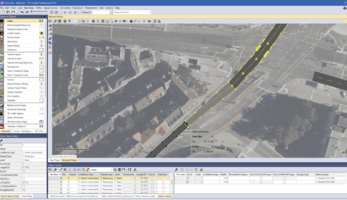
PTV Vissim is a microscopic, time-step-oriented and behaviour-based simulation tool for modelling urban and rural traffic as well as pedestrian flows. With the new features developed in the MORE context, it offers improved modelling of complex urban realities, including their interactions and disruptions. Vissim enables simulations, signalling and real-time visual and micro-interactions between pedestrian flows, bicycles and public and private transport. It provides realistic and dynamic microscopic modelling of lane driving, parking and loading activity for both motorised and active travel modes, taking into account the influence of users on streets, kerbsides and public spaces.
Good Example
PTV Vissim was used to model dynamic traffic management at London Luton Airport after a major fire damaged a car park. The simulation evaluated temporary drop-off zones and pedestrian flow, ensuring the optimal design could efficiently handle peak traffic and minimize delays during the rebuild. The implemented solution's real-world performance matched the model's predictions.
Contacts
PTV Group
https://www.ptvgroup.com/de/kontakt [at]