Urban Mobility Best Practice Showcase - MOVE21: The multifunctional neighbourhood hub in Altona
The city of Hamburg, Germany’s second-largest city, with over five million residents and its bustling port – the third busiest in Europe – represents a key industrial hub in Northern Germany. Notably, more than 40% of goods arriving at the port are transported by truck to the Hamburg hinterland. In December 2019, the city adopted an updated Hamburg Climate Plan, targeting a 55% reduction in greenhouse gas emissions by 2030 (compared to 1990 levels).
As a major metropolitan city, Hamburg faces the challenge of modernizing critical national and international transport hubs. Each day, approximately 40,000 trucks enter the Port of Hamburg, and over 10% of Germany’s rail freight begins or ends there. Additionally, around 500,000 people commute in and out of Hamburg daily. In addition, traffic on regional and transnational routes is expected to grow, making digital transformation and advanced technologies essential for managing this increase.
Over the past years, Hamburg has served as a testing ground for innovative logistics solutions to address the rise in deliveries, including the use of micro-hubs for consolidating goods from various companies, paired with last-mile delivery via cargo bikes or on foot. A pilot program by UPS in Hamburg’s city center demonstrated the benefits of this model, indicating that deploying 100-150 micro-hubs could enable 40% of last-mile deliveries to be completed by cargo bikes.
Within the MOVE21 project, the Hamburg Living Lab, located in the district of Altona, focused on the implementation of mixed-use micro-hubs designed for both passengers and freight, promoting innovative transport strategies. These hubs were strategically placed in diverse urban areas to test and develop integrated solutions that meet the community's mobility needs while promoting sustainability. Key benefits of the micro-hubs include:
- Reducing Traffic congestion by consolidating deliveries at one central location
- Enabling emission-free last-mile deliveries through the use of e-cargo bikes
- Promoting social inclusion by combining logistical services and social support to residents and homeless people.
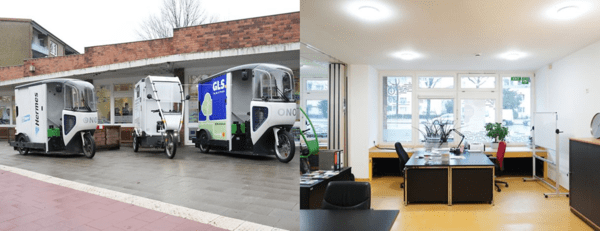
In particular, the multifunctional Holstenstraße neighbourhood hub combines sustainable logistics and social offers - all under one roof. A previously vacant building, owned by a municipal housing company has been redesigned to a multifunctional hub that integrates sustainable solutions for transporting goods combined with a socio-cultural hub for citizens. In doing so, the hub has been promoting a more liveable and sustainable neighbourhood, combining essential services with environmentally friendly logistics solutions.
The micro-depot inside the hub allows for the brief interim storage of goods and merchandise before they are transported by smaller e-vehicles or e-cargo bikes for last-mile and first-mile logistics, which reduces emissions and alleviates traffic issues, particularly in denser neighbourhoods.
At the same time, the hub provides social services by a team of on-site volunteers and staff, such as:
- Advisory services for the residents facing unemployment, debts and housing challenges as well as offering training and educational programmes.
- A social kiosk where donations, including clothing, toiletries and food are distributed to people in need.
Overall, the multifunctional neighborhood hub has proved effective in improving last-mile logistics operation by enabling emission-free and service-oriented goods transport within the neighbourhood as well as opening social, cultural and leisure offerings for people in the neighborhood, while promoting inclusion and social cooperation.
The data and feedback collected from users of the Holstenstraße hub within the MOVE21 project can be transferred for scaling this model to other locations in Hamburg and beyond. By combining sustainability with social equity, Hamburg is paving the way for further traffic reductions through cooperation and new transport concepts.
Author: TRT TRASPORTI E TERRITORIO