Why Accessible, Walkable Cities Matter: Insights from CIVITAS Cities at COP30
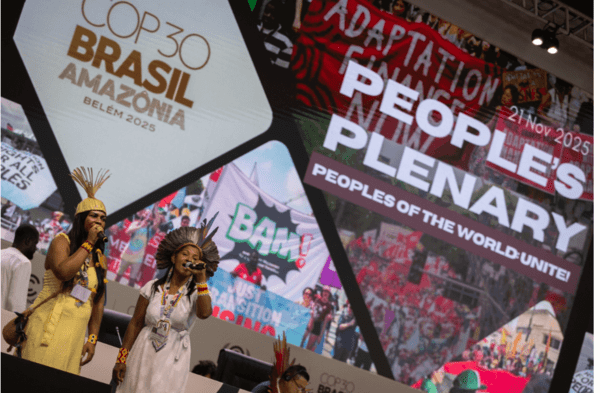
Image by Author licensed under All content Copyright © 2024 UN Climate Change
As the world gathered at COP30 to discuss the pathways toward low-emission futures, we must reflect not only on how we transition, but for whom and at what cost. Transforming transport systems is a central pillar of climate action. Yet civil society, including gender-equity advocates, has long warned that shifting from fossil fuels to new technologies cannot replicate the same extractive and dominating structures that have harmed people and the planet for decades.
Against this backdrop, CIVITAS Cities, working through the Projects AMIGOS, REALLOCATE, Elaborator, JUST STREETS, and SPINE are already demonstrating how people-centred, walkable and accessible mobility systems can answer COP30’s call for a just transition. Their city-level innovations show that climate action grounded in care, well-being and reduced material demand is not only possible, but already underway across Europe.
The mineral footprint of the Green transition
By 2050, demand for raw minerals such as lithium, cobalt, and nickel is expected to increase by 500%. These so-called “critical minerals,” essential for low-emission transport technologies, are overwhelmingly extracted from the Global South. This intensifies unequal global exchanges in which Southern lands, labour, energy, and time are sacrificed to power a green transition that largely benefits the North.
This mining boom is already linked to Indigenous rights violations, exploitative and toxic working conditions, human trafficking, forced labour, and child labour. Without structural change, the shift to electric mobility risks reproducing former exploitation patterns of racialised sacrifice zones.
CIVITAS Project make the case for walkable, accessible, people-centred cities
Through CIVITAS Projects: AMIGOS, REALLOCATE, Elaborator, JUST STREETS, and SPINE, pilot cities are redesigning public transport systems and urban spaces and prioritising public, accessible, and safe modes of mobility.
Research and Innovation, and subsequent investment in active mobility, walkable neighbourhoods, and inclusive public transport, must focus on responding to people’s needs and support a mobility of care. Women’s daily journeys often involve multiple short trips—school drop-offs, grocery shopping, caring for elderly relatives-which makes them highly dependent on well-connected and safe walking environments and transit systems. Yet women and girls, in all their diversity, face disproportionate barriers and risks in today’s transport systems.
A truly equitable mobility system must ensure safety, affordability, disability accessibility, and gender responsiveness for people of all ages, abilities, and identities.
Just transition means justice at its core
Responding to the climate crisis requires a profound transformation of our economies and societies. But energy transition is not automatically a just transition. A new system built on extractive mineral supply chains, human rights abuses, or the unpaid and undervalued labour of women cannot be called “just.” A just transition demands a shift towards societies built on care, equity, and shared power.
CIVITAS welcomes the increasing recognition within the just transition UNFCCC processes of care work, informal work, and social protection as essential climate infrastructure. These must be central pillars of national just transition plans related to sustainable mobility.
At COP30, representatives from civil society called and obtained the establishment of a global mechanism on just transition—the Belém Action Mechanism—to ensure that care work, gender-responsive policies, and social protection are embedded in the institutional architecture of climate transition.
A Call for Truth and Transformation
The COP 30, "the COP of Truth" in President Lula's words, had confronted the reality that justice is not optional; it is foundational.
A walkable, accessible, inclusive city is not just an urban design choice: it is a climate solution rooted in well-being, social justice, and reduced dependence on extractive mineral pathways. Let us deliver with our cluster cities, the transformation the world urgently needs, a truly just transition.
Author: Floridea Di Ciommo