Tampere Launches Finland’s First Commercial Automated Bus Service
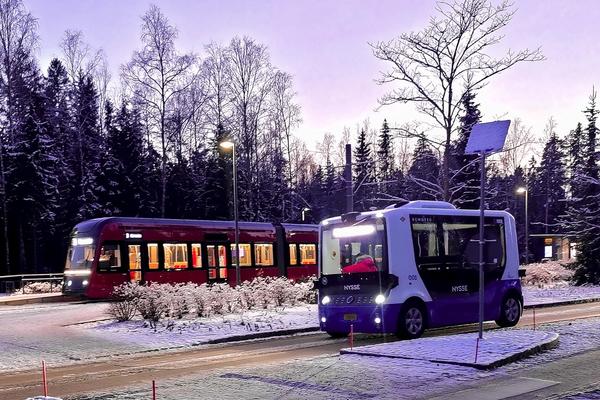
Image from Steinbeis Europa by Lisa Marie Hanss
On 17 November 2025, metaCCAZE project partners the City of Tampere, REMOTED, and Tampere University officially launched Finland’s first commercially operated automated bus service. Operated by Nysse, the Tampere regional public transport authority, the route features an OHMIO LIFT vehicle equipped with advanced LiDAR and camera technologies. Running as line 301 between the Lintuhytti residential area and the Hervantajärvi tram stop, it marks not only Finland’s first commercial automated bus line but potentially the first in the Nordics. This milestone advances the region’s vision for climate-neutral, connected, and automated urban mobility.
As part of the metaCCAZE project, Tampere has served as a living lab for testing and developing automated public transport. Since January 2024, partners have worked closely with local stakeholders and citizens to select and prepare the route now in operation. The City of Tampere manages infrastructure such as bus stops, while Nysse oversees ticketing and real-time information systems. In addition to vehicle operation, REMOTED is developing remote control and charging solutions, and Tampere University leads co-design, surveys, and monitoring activities.
A fully integrated part of public transport that runs every day
he OHMIO LIFT vehicle, recently acquired by REMOTED, is equipped with advanced LiDAR and camera systems, offers seating for 12 passengers, and is certified as an M2 category vehicle under EU regulations. The automated bus runs daily using the standard Nysse fare system, with timetables and route information available in the Nysse journey planner. When the automated bus is charging or under maintenance, a conventional minibus ensures service continuity. Service hours are 06:00–23:00 on weekdays and approximately 09:00–22:00 on weekends, with a short charging break around midday.
From safety driver to remote supervision
Initially, safety driver will remain on board. By spring 2026, the service aims to transition to fully driverless operation, monitored remotely by REMOTED from a dedicated control centre. Additional LiDAR and camera systems will enable Level 4 automation, allowing remote control and true autonomous driving without human intervention. The vehicle also features advanced battery technology designed for harsh Finnish winters.
Testing phase
The testing phase will run for one year, with the option to extend for two more. Alongside technical evaluation, the project will assess economic viability and public acceptance. A passenger survey will soon be launched to gather feedback and improve the service.
More about metaCCAZE Trailblazer City, Tampere
Tampere plays a leading role in metaCCAZE by pioneering automated mobility. The goal is to move safety operators from inside vehicles to remote centres, enabling monitoring of multiple AI-driven vehicles for greater efficiency and reduced costs. Three additional automated vehicles will join the fleet soon.
More about metaCCAZE
The metaCCAZE project, aims to revolutionise mobility in European cities, serving both passengers and freight, with innovative electric, automated, and connected solutions designed to make transport smarter, net zero, and more efficient for all. In the vibrant streets of four trailblazer cities – Amsterdam, Munich, Limassol, and Tampere – metaCCAZE tests and demonstrates cutting-edge technologies that support shared zero-emission mobility solutions for people and goods, contributing to climate neutrality. Successful technologies and activities will be shared and implemented to six follower cities – Athens, Krakow, Gozo, Milan, Miskolc, and Poissy, Yvelines (Paris region).
Author: Lisa Marie Hanß