Streets for All: Mobility-as-a-Right & School Streets
Introduction
On the 26 February 2025, REALLOCATE, UPPER and Just Streets came together to jointly organise the webinar "Streets for All: Mobility-as-a-Right & School Streets", which brought together experts, city representatives, and project partners to discuss inclusive urban mobility. With over 200 participants attending, the event focused on two key topics: mobility justice and accessibility for vulnerable groups, and school streets addressing the specific mobility needs of different age groups.
Mobility as a Right (MaaR)
The first topic was presented by Charlotte Hauri and Mário Alves from the International Federation of Pedestrians (IFP). They emphasised the significance of pedestrian access in public transport planning, pointing out that walking plays a crucial role in the beginning and end of most transport journeys.
Key takeaways:
- Over 85% of public transport users in Europe walk to transit points.
- Walking times vary greatly across age groups and abilities, impacting accessibility.
- The need for reality-checked catchment areas rather than simplistic distance-based models.
- The impact of poor pedestrian infrastructure, such as pedestrian underpasses and poorly designed crossings.
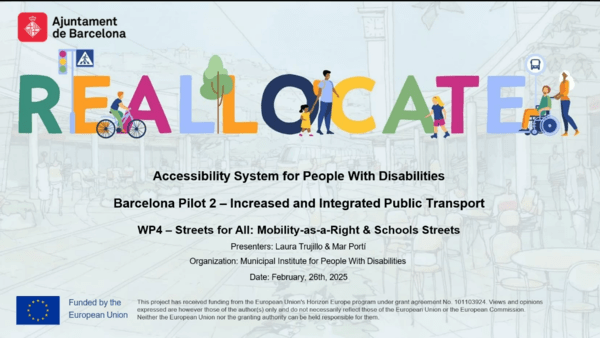
The second presentation was led by Barcelona's representatives, Mar Portí and Laura Trujillo, who presented their city's accessibility initiatives (REALLOCATE), including:
- A door-to-door transport service for people with reduced mobility.
- Improvements in public transport accessibility, with 93% of metro stations now accessible.
- The REALLOCATE pilot project aimed at optimising transport for people with disabilities through shared vehicle journeys.
The discussion raised questions about the standardisation of data collection in pedestrian planning and the challenges of ensuring comprehensive mobility justice.
School Streets
The second part of the webinar was introduced by Pierre Soulard from Lyon Métropole, who spoke about public space and street design around high schools.
Data showed that teenagers and children are overrepresented in pedestrian-related accidents, with 68% of such incidents occurring around middle schools.
Key interventions in Lyon included:
- A large-scale field survey to identify mobility issues around schools.
- Implementation of pedestrian-friendly streets, school zones, and urban redesign projects.
- Engaging students in co-creation processes to ensure designs meet their needs.
A thematic exchange followed between Warsaw (REALLOCATE) and Kozani (JUST STREETS), with Aleksandra Puzyńska (Warsaw) and Dimitris Ziouzios (Kozani) presenting their respective projects.
Warsaw’s main points:
- Implementing a school street model that restricts vehicular access during peak hours.
- Extensive community engagement and co-creation with students, parents, and local authorities.
- Using VR technology to visualise proposed interventions.
Kozani’s main points:
- Addressing narrow streets, lack of sidewalks, and high traffic volumes around schools.
- Implementing passive traffic bans, improved pedestrian crossings, and educational campaigns.
- Overcoming initial resistance from parents and teachers through continuous engagement.
Key challenges and solutions:
- Community resistance: many residents resist removing parking spaces or restricting vehicle access. Both cities emphasised the importance of education and phased interventions to build public support.
- Long-term sustainability: ensuring lasting change requires integrating new designs into policy frameworks and fostering a cultural shift towards sustainable mobility.
- Scaling up: successful pilots need to be expanded to a city-wide level.
Conclusion
The webinar underscored the importance of prioritising pedestrian accessibility and school streets to create safer and more inclusive cities. The projects presented tangible solutions for mobility justice and child-friendly urban planning, demonstrating the power of collaboration across cities and stakeholders.
The session concluded with a call to action: to continue fostering dialogue, sharing best practices, and scaling up successful interventions to make "streets for all" a reality.
The REALLOCATE Project wishes to extend a thank you to UPPER, Just Streets and EuroCities for their support in organising this successful webinar, and everyone who participated, making it a productive and lively exchange.
For those who couldn’t make it—or if you’d like to watch it again—watch the recording here.