Magyar CIVINET focuses on traffic measurement and analysis in Székesfehérvár
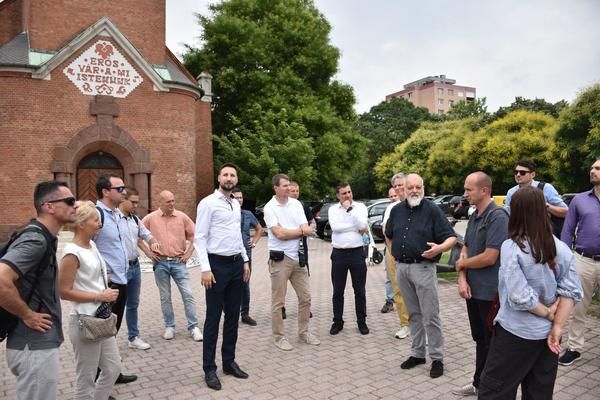
Image by Mobilissimus Kft.
Magyar CIVINET organised its last meeting on the topic of Traffic Measurement and Analysis in the city of Székesfehérvár on 26 June 2024, with the support of Griffsoft.
The welcome to the event was given by Antal Gertheis, CEO of Mobilissimus, which is also the secretariat of the Magyar CIVINET. As part of the welcome, Anthal also spoke about the various CIVINET activities.
Attila Mészáros, the Deputy Mayor of Székesfehérvár and the President of the CIVINET, welcomed participants and reported on the current transport challenges of the city and the actions that have been taken in response to them. In addition to road improvements, 30 km of cycle paths have been built in the city over the past five years, and plans are already in place for the BuBa (Budapest-Balaton Cycle Route) section within the city. The city has also taken important steps in the field of public transport. More specifically, the local bus network is being upgraded step-by-step to connect different parts of the city and to open up new suburban areas. Students are able to buy a monthly bus pass for the price of a line ticket, which has almost tripled the number of passes sold and has provided an alternative to the "mamataxi". Work is also under way with Volánbusz, the service provider, to coordinate local and intercity services. There are also aims to implement the intermodal hub, but funding is currently lacking.
Zsolt Nagy, Head of the Transport Department of the Mayor's Office, presented the challenges and solutions for the construction of cycle lanes. The aim with the implementation of the lanes is to expand the network and improve safety. A comprehensive cycle network plan has been referred to when deciding where to implement the lanes; in addition to the cycle facilities, almost 1,000 cycle stands have been completed thus far. The main considerations taken into account during the planning programme are the needs of cyclists, preservation or possible creation of green spaces and, utility network. In some cases, a complete cross-sectional reconstruction was required, while in others cases creative and individual solutions were needed to preserve the existing tree line and valuable deciduous trees while ensuring the safety of cyclists and pedestrians. On the iconic Várkörút, a raised tree line was installed to separate the two lanes of traffic, cycle lanes were created alongside the two lanes and a 30 km/h speed limit was introduced. Since the modifications, no accidents have been reported in the affected section.
In his second presentation, Zsolt Nagy presented on the importance of the newly available tools for traffic measurement and analysis. He briefly described the previous traffic measurement procedures, which were typically based on manual counting, and highlighted the specificities of the city in terms of traffic flow. The new, innovative traffic counting and data analysis systems that are being used are based on three different technologies:
- Lidar system: for simultaneous traffic counting of several traffic lanes. The data are integrated into the online visualisation interface of the traffic light system and are used primarily for traffic light planning.
- Urban Analytics: identification, counting and analysis of vehicle movements within and between intersections, broken down by vehicle category, with a dedicated interface for data visualisation. This is currently under development.
- Visible Crossing: SafeXone advanced safety pedestrian crossings that measure both pedestrian and vehicle traffic in addition to visibility functions, and even provide data on how many drivers have not stopped at the crossing despite the presence of a pedestrian crossing.
New technologies save the high personnel requirements of traffic recording and can be used not only to capture a snapshot, but also to provide continuous data. It is currently challenging, however, to process and utilise such a large amount of data within the municipality.
Tamás Batinkov, Head of the Development Group of Griffsoft Zrt., presented in more detail the Urban Analytics system, which the company developed with the aim of creating an urban traffic monitoring system supported by artificial intelligence and capable of simulation. Such a system is not only more affordable, but also supports decision-making at the municipal level. The system is capable of detecting, classifying and categorising objects. Images from camera sensors are processed locally by nano computers, which upload an aggregated and GDPR-compliant dataset to the cloud. Pilot projects are underway in several locations across the country. The latest of these pilot projects was launched in Budapest and is characterised by nine sensors that were deployed at different nodes within the capital. The dashboard interface, which provides data visualisation and analysis, can display traffic data that is broken down by location or aggregated, with graphs and a breakdown by vehicle category. The data captured provides the basis for Urban Analytics modelling solutions. Macro-simulations are based on gravity models that generate simulation data based on emissions and traction, while micro-simulations examine the effects of small-scale interventions. The system can also integrate other data, such as household surveys, zonal data and census data.
Viktor Knezevics, Managing Director of the Szegedi Transport Company, reported on the experiences of the Szeged sensor-based passenger counting. In the city, the sensor-based passenger counting was launched as part of the SASMob project to promote sustainable transport modes. Fixed measuring points are located on the Algyői road and on the Belvárosi bridge. In addition to the fixed counters, 60 public transport vehicles are equipped with sensor counters to monitor the number of passengers. The data is collected using Power BI, and the current numbers are uploaded to the dedicated MS Azure storage in five-minute blocks. These data are published and available on the Szeged city website and are used to produce monthly transport publications in Hungarian and English. The accuracy of the sensors is periodically checked by manual measurement, and they are currently operating at 85-90% accuracy. To monitor public transport traffic, the city administration also uses ticket sales data, complementing the use of sensor data to optimise the network and operations.
In Szeged, the pay parking zone has recently been expanded and to cope with the additional control tasks that the expansion of the area entails, experiments with e-roller parking enforcement have been started. Inspectors are provided with the necessary protective equipment and visibility enhancing accessories to work safely and are now confident in using the roller parking enforcement equipment. With this innovative solution, inspectors can cover nearly four times the area in the same time frame, and the smartphone camera image analysis that is used for eligibility checks can identify license plates with more than 98% accuracy.
Martin Márku, Senior Data Analyst, presented the traffic counting and data analysis work of BKK Center for Budapest Transport. In 2021, BKK established a data centre, which primarily provides data for strategic planning, infrastructure development and external communication. Before 2021, the capital could only rely on manual counts for all but public transport, but now these have been largely replaced and manual counts have become a complement to automated counting. BKK is also constantly experimenting with innovations in technology, such as DataFromSky camera image analysis software. Furthermore, in partnership with Google, they aim to further optimise the traffic light system based on traffic data from the mapping service. A model developed for estimating cycling traffic predicts cycling traffic with 99.5% accuracy by comparing preliminary measurements with fixed measurement points, even at locations where no continuous measurement is available.
Led by Zsolt Nagy, the participants took a walk to the centre of Székesfehérvár, where they were shown the traffic counting tools presented in the programme and some cycling developments.
Afterwards, the transport experts and city decision-makers visited the Ikarus bus factory, where representatives of Ikarus Zrt. and its Chinese partner Greenway Kft. welcomed the members of the CIVINET community. A brief presentation by Ikarus showed how the plant is expanding its iron structure manufacturing portfolio with the production of railway carriage chassis and truck bodies, building on its bus manufacturing competencies. The company's current models are the 12-metre, fully electric 120E solo and the 8.5-metre Ikarus 80E midi bus, but further models are being developed. The buses are already in operation in several Hungarian cities, namely Kaposvár, Budapest and Székesfehérvár, as well as in Germany and Romania. At the time of the study visit, vehicles were being built at the workshop to respond to a Polish order. The vehicles are equipped with advanced technology, including sleep monitoring, blind spot monitoring and lane tracking and can also be ordered with automatic camera or passenger counting devices based on infrared technology. The main components are made locally, but the driveline is made in China and a number of European-made parts are also used.
Author: Magyar CIVINET