Limassol Powers Smarter Bus Charging with NTUA’s Planning Tool
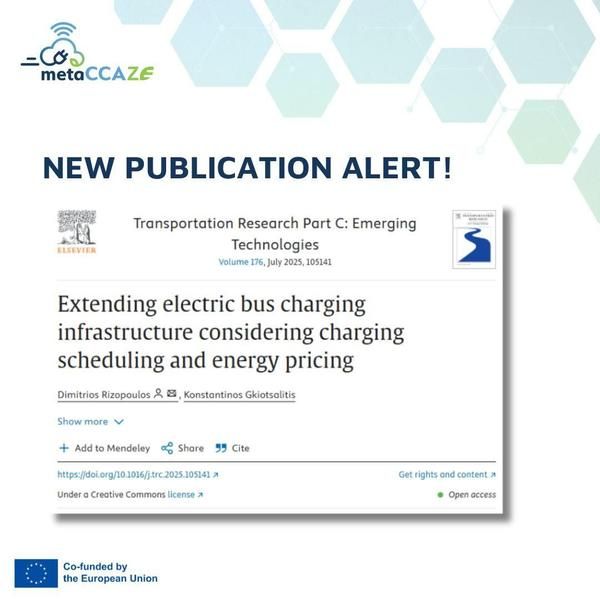
Image from Steinbeis Europa Zentrum by Lisa Marie Hanß
How can cities expand their electric bus networks without overloading the power grid or transport budgets? A new strategic planning model developed by researchers at the National Technical University of Athens (NTUA), a key partner in the metaCCAZE project, offers a cities a data-driven answer to ensure chargers are installed where they’ll be most cost-effective and efficient, without straining the power grid or transport budgets.
Drawing on real-world conditions from Limassol, Cyprus, the model identifies the most cost-effective and efficient locations for new electric bus charging stations. By factoring in installation costs, electricity pricing schemes (including Time-of-Use tariffs and peak demand charges), and existing bus routes, the tool ensures that charging infrastructure supports operational efficiency while staying within budget.
Crucially, the model balances the needs of transport operators—keeping buses on schedule and avoiding unnecessary detours for recharging—helping cities plan smarter for the electrification of their public transport systems.
Read the full paper:
Rizopoulos, D., & Gkiotsalitis, K. (2025). Extending electric bus charging infrastructure considering charging scheduling and energy pricing. Transportation Research Part C.
NTUA’s role in metaCCAZE
The Department of Transportation Planning and Engineering at the National Technical University of Athens (NTUA) is a globally recognised center of excellence in transport research and innovation. Its mission is to educate transport engineers and advance science in transport planning and engineering. In metaCCAZE, NTUA is the technical coordinator and leads WP2, focused on developing an open, smart toolkit that integrates electrification, automation, and connectivity to support zero-emission shared mobility systems.
Limassol: a Trailblazer City
As one of metaCCAZE Trailblazer Cities, Limassol focuses on four exciting use cases to reduce peak traffic and congestion. Cooperating with MaaSLab, Etaireia Metaforas Epibaton Lemesou (E.M.E.L.) LIMITED, Oxygen for Democracy, nextbike Cy Ltd and MobiLysis, the city is committed to reducing its reliance on cars. Learn more about the living lab Limassol’s role as a Trailblazer City here.
Author: Lisa Marie Hanß