Inclusive Shared Mobility: Shaping resilient, safe and inclusive systems for shared mobility
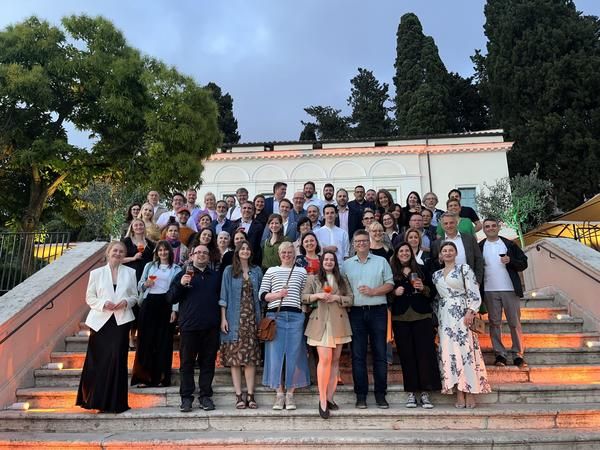
Image by CIVITAS Initiative
Organised by CIVITAS, in cooperation with Roma Servizi per la Mobilità,CIVINET Italia and Roma Capitale, the joint CIVINET–PEF event: Inclusive Shared Mobility: Shaping resilient, safe and inclusive systems for shared mobility, was held in Rome on 12–13 May 2026 to explore how shared mobility can contribute to more resilient and people-centred urban transport systems.
Shared mobility as part of the public transport fabric
Opening the event, speakers reflected on how rapidly shared mobility is evolving in European cities.
Representing the European Climate, Infrastructure and Environment Executive Agency (CINEA), Octavia Stepan highlighted the role of the wider CIVITAS community in helping cities test and scale mobility solutions through cooperation and knowledge exchange.
Rome’s Deputy Mayor for Mobility, Eugenio Patanè, echoed these remarks, reflecting on the importance of European city cooperation in shaping the Italian capital’s mobility transformation.
Peer-to-peer exchange, Patanè argued, has been one of the core strengths of the CIVITAS Initiative over the past twenty years, particularly as cities grapple with similar questions around regulation, public transport integration and reclaiming urban space for citizens.
Ahead of the site visits, Patanè encouraged participants to assess Rome’s mobility interventions critically. “Look at the city with a critical eye,” he said. “Tell us what works and what does not. Where you could have done better and why.”
The Deputy Mayor stressed that shared mobility should not be seen as a standalone solution, but as one part of a wider urban mobility transition alongside public transport, cycling infrastructure and pedestrian space.
“Shared, inclusive and safe mobility is not the miracle answer to the problems of the 21st century city,” Patanè said, “but one of the tools with which we can try to give cities back to their inhabitants.”
From policy to practice
Participants explored the theme of inclusive shared mobility through four interconnected lenses: policy, governance, infrastructure and behaviour.
To examine these themes in practice, participants split into two parallel forums: the CIVINET Practitioners Forum and the CIVINET Politicians Exchange Forum (PEF).
The CIVINET Practitioners Forum focused on the day-to-day realities of implementing shared mobility systems. Discussions explored operational challenges, including infrastructure gaps, financial sustainability, service coverage and integration with public transport.
The session featured presentations from all CIVINETs (CIVINET.BE,CIVINET Czech and Slovak Republics, CIVINET Deutscher Sprachraum,CIVINET Greece-Cyprus, CIVINET Iberia,CIVINET Italia,CIVINET Nederland,CIVINET Polska,CIVINET Romania, CIVINET Slovenia-Croatia-South East Europe, CIVINET Ukraine,Magyar CIVINET), which highlighted a range of experiences from across Europe, including subsidised e-bike schemes, bike-sharing systems and efforts to expand services into suburban and peri-urban areas.
Speakers also reflected on the financial pressures facing operators and cities alike. Luka Vidan, representing CIVINET Slovenia-Croatia-SEE, highlighted the fragility of the sector, noting that many car-sharing companies struggle to remain financially viable in the long term without supportive frameworks or wider public acceptance.
A recurring theme throughout the forum was that shared mobility is increasingly moving beyond leisure and tourism towards becoming a more integrated part of urban transport systems. Participants stressed that shared mobility services must connect effectively with buses, metro stations and wider cycling networks if cities want to encourage lasting modal shift away from private cars.
In parallel, the CIVINET Politicians Exchange Forum brought together city representatives from across Europe, including perspectives from Elio Tomassetti (President of Rome’s 12th City District), Ana Agudo (Deputy Mayor of Granada), Mihai Tonsciuc (Councillor for the City of Ploiești) and Chrysostomos Kalogirou (Thessaloniki) and moderated by Arianna Americo (Eurocities).
A central theme throughout discussions was that innovation alone is insufficient if services are not economically viable, accessible and institutionally sustainable. Several representatives reflected on the difficulty of balancing ambitious mobility goals with financial realities, particularly in suburban and peri-urban areas where demand is often lower and operational costs higher.
Ana Agudo shared lessons from Granada’s two-year on-demand mobility pilot, stressing that successful mobility systems require long-term governance structures and metropolitan cooperation rather than isolated city-level approaches.
Affordability also emerged as a key issue. Participants repeatedly returned to the idea that mobility should be treated as a public good rather than purely a market-based service. Agudo illustrated the Granada Balance, which emphasised the need to balance
innovation, environmental ambition, economic realism, social inclusion, technological change, and metropolitan coordination.
Mihai Tonsciuc's presentation focused on how behavioural economics can support more sustainable mobility choices, particularly among students. Despite offering free public transport for students in Ploiești, usage rates remain significantly lower than expected. According to figures shared during the discussion, around 15,000 students have requested access to the scheme out of a total student population of 33,000, illustrating how deeply ingrained private car use remains in some urban areas. To address this issue, Ploiești showed that simplifying access to public transport can substantially increase sustainable mobility use among young people.
Elio Tomassetti also highlighted Roma Servizi per la Mobilità’s on-demand public transport service, ClicBus ATAC, Rome’s new on-demand public bus service, designed to improve mobility in peripheral and lower-density neighbourhoods where traditional fixed-route buses are less efficient. The service operates seven days a week as a pilot between September 2024 and December 2025, improving accessibility in areas less well served by traditional public transport.
Co-creating solutions for inclusive mobility
Interactive workshops allowed participants to move from identifying challenges towards developing practical solutions.
Infrastructure discussions focused heavily on reallocating urban road space to support safer and more inclusive cycling. Participants proposed solutions including cycling streets, separated cycling infrastructure and traffic-light priority systems to improve safety and accessibility for a wider range of users.
Importantly, discussions framed cycling not only as a mobility option for confident cyclists, but as a mode that should be accessible to children, older people, parents, migrants and less experienced users.
Workshops also highlighted the importance of public engagement and co-creation. Participants argued that infrastructure alone is not enough without political support, community involvement and public acceptance.
Behaviour-focused discussions identified digital accessibility, lack of awareness and car-centred mobility cultures as major barriers to shared mobility uptake. Participants highlighted the importance of education and communication campaigns, alongside initiatives such as Bremen’s Shared-North-Squared project, which works with planners and developers to better integrate shared mobility into urban design.
Governance-focused workshops explored barriers including limited digital skills, lack of accessible information, underrepresentation in planning processes and persistent car-centred mobility cultures. Participants highlighted the importance of education and communication campaigns, alongside initiatives such as Bremen’s Shared-North-Squared project, which works with planners, architects and developers to better integrate shared mobility into urban design.
A panel discussion on the second day brought together Enrico Stefàno (Lime), Elisa Lombardi (Doctorbike), Chiara Di Majo (Roma Servizi per la Mobilità) and Vittorio Gattari (Dott) to reflect on the operational realities of shared mobility in Rome. Discussions focused on the balance between regulation, financial sustainability and accessibility, particularly in suburban and peri-urban areas.
Speakers highlighted how regulation has helped shift shared mobility from a service associated mainly with tourism and leisure towards becoming a more integrated part of the city’s transport network. The panel also explored the importance of coordination between operators and public authorities, with several speakers stressing that integration with public transport, fair regulation and service coverage beyond city centres will be essential for the long-term success of shared mobility systems.
When in Rome
On the second day, participants explored shared mobility interventions across Rome through a series of site visits.
One group joined a cycling tour along the Tiber riverbank using e-bikes provided by Dott. While the route benefited from a separated cycling lane and offered an attractive active mobility experience, participants also observed damaged surfaces, potholes and cobblestones that may create barriers for less confident cyclists or older users.
Another site visit focused on the Vatican area cycling tour, demonstrating how mobility interventions can support wider urban regeneration goals while improving connections between cycling, walking and public transport.
The third site visit featured a walking tour of the Colosseum metro station area. Made up of approximately 50 kilometres, the route connects major historical landmarks, green spaces and outer districts.
Throughout the visits, one message remained consistent: inclusive shared mobility requires more than technology alone. Participants repeatedly emphasised the importance of governance, affordability, integration and public trust in building mobility systems that work for everyone.
Cities in transition
As cities continue to rethink mobility systems in response to climate, accessibility and social challenges, the joint CIVINET/PEF event highlighted both the complexity of the transition and the growing momentum behind more integrated, inclusive and people-centred approaches to urban mobility. Participants repeatedly emphasised the importance of governance, affordability, integration, political leadership and public trust in building mobility systems that work for everyone.
Photos from the event are available at this link
Author: Robyn Fleming