European City Leaders Unite in Vilnius to Advance Sustainable and Competitive Urban Mobility
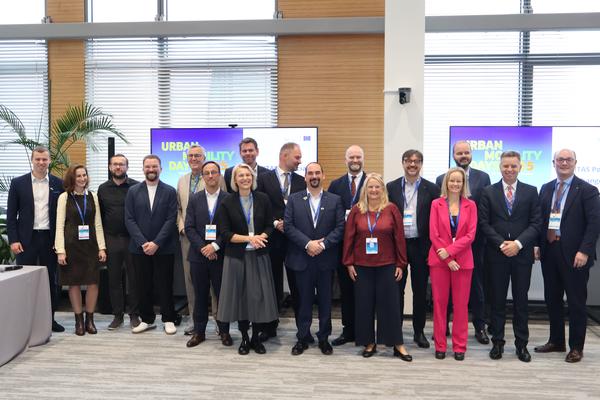
The Politicians Exchange Forum (PEF), established under the CIVITAS Initiative, serves as a robust and open platform for local politicians from the CIVITAS City Network to actively engage, collaborate, and exchange knowledge in the field of sustainable urban mobility.
Jointly supported by ICLEI and Eurocities, it also provides a unique opportunity for local leaders to connect directly with high-level representatives of the European Commission and stakeholders from across the mobility ecosystem - fostering dialogue, idea-sharing and joint action on Europe’s most pressing urban mobility challenges.
Held this year in Vilnius on 30 September alongside the Urban Mobility Days 2025, the Forum gathered city leaders, European Commission officials, and mobility innovators to explore how sustainable urban mobility can strengthen Europe’s competitiveness.
Opening the event, Andrius Grigonis, Vice Mayor of Vilnius, welcomed participants and highlighted his city’s commitment to innovation and people-centred transport solutions.
Aligning Competitiveness and Sustainability
In her keynote address, Isabelle Vandoorne (European Commission, DG MOVE) presented the EU’s latest strategic initiatives - including the Competitiveness Compass, Clean Industrial Deal, Automotive Action Plan, Start-up and Scale-up Strategy, and Union of Skills. These frameworks aim to boost innovation and industrial leadership in clean mobility. She encouraged cities to engage actively with these strategies, noting that “sustainability and competitiveness must go hand in hand” and that cities are “key enablers of Europe’s green industrial transformation.”
The Commission’s approach focuses on simplifying regulation, expanding funding instruments and strengthening skills development - providing the enabling conditions for urban mobility innovation to thrive.
City Leaders Call for Co-Creation, Simplified Rules, and Direct Funding
The PEF meeting was divided into two parts, first a closed session for invited politicians, and second, an open session also including key industry stakeholders. In the first session, moderated by Matthew Bach (Regional Director of ICLEI Europe), city political representatives exchanged views on how to mobilise European cities for sustainable and competitive mobility. Discussions centred on three main themes:
- Policies & Regulation: City leaders called for consistent, long-term frameworks that enable innovation “without backtracking on sustainability.” While welcoming regulatory simplification, participants warned against lowering environmental or safety standards. They urged a formal role for cities as co-creators of EU mobility policies to ensure that local realities are fully reflected.
- Public Procurement & Deployment: Participants agreed that procurement must evolve to support innovation. “Overly complex, rigid tenders” often exclude start-ups and deter new entrants. Cities proposed simplified, outcome-based procurement, joint tenders, and smaller lots to open opportunities for innovators. They emphasised that quality and sustainability, not just price, should guide procurement to help Europe’s own industries scale.
- Financing & Investment: Funding gaps remain a pressing concern. With the next EU budget cycle approaching, city leaders called for direct access to EU funds, urban earmarking within major programmes and faster funding approvals. They also advocated blended finance models and public–private partnerships to bridge the “valley of death” between pilot projects and large-scale deployment.
Across all topics, cities expressed a unified message: simpler regulation, secure funding and co-designed policy frameworks are essential to deliver sustainable and competitive mobility at scale.
As Matthew Bach concluded, “Cities are not just implementers - they are innovators, investors and partners in Europe’s mobility transformation.”
Bridging the Innovation Gap: Start-Ups Share Their Realities
In the 2nd, open session, moderated by Marc Rozendal (EIT Urban Mobility), entrepreneurs joined city leaders to share first-hand experiences from the innovation frontlines.
- Maxim Romain (Dott) highlighted how fragmented regulations across Europe hinder scale for micro-mobility providers. “We often need to design different vehicles for different markets,” he said. He called for EU-wide standardisation of technical rules and more accessible funding for quality operators.
- Olivier Binet (Karos Mobility) described similar barriers in car-pooling, where each country has distinct laws. France’s 2019 law recognising car-pooling as a form of public transport “totally changed the game,” he said, urging the EU to replicate and share best legal practices across borders.
- Vytautas Višinskis (Walk15) discussed the financing gap that many start-ups face after successful pilots. “Often the solution works and the city is interested, but once the grant ends, there’s no clear path to procurement.” He proposed linking pilot programmes to follow-up procurement opportunities and the alignment of innovation budgets with purchasing budgets to ensure continuity.
Moderator Marc Rozendal noted that “the fact that mayors and entrepreneurs are highlighting the same barriers - and the same solutions - shows that Europe is ready to act together.”
Shared Priorities and European Momentum
The discussions throughout the Politicians Exchange Forum, from the closed session among city leaders to the open dialogue with innovators and industry, revealed a strong and growing consensus on the future direction of sustainable urban mobility in Europe.
Across all sessions, participants agreed that simpler, more coherent regulations, value-based and flexible procurement, alongside direct, predictable funding, are essential to unlock innovation and accelerate the mobility transition. Both city leaders and entrepreneurs highlighted that Europe must move from pilots to large-scale deployment, ensuring that successful innovations can be scaled up and sustained.
Participants underlined Europe’s unique strength: a collaborative ecosystem where cities, companies, and communities work in partnership to shape the future of mobility.
As the meeting concluded, attendees joined the Urban Mobility Days 2025 opening ceremony - carrying forward a shared ambition to make European cities more sustainable, innovative, and globally competitive through partnership, trust, and collective action.
Watch the video on the Politicians Exchange Forum, here.
To learn more about the Politicians Exchange Forum, read the introductory page.