CIVINET reflections from Urban Mobility Days 2022
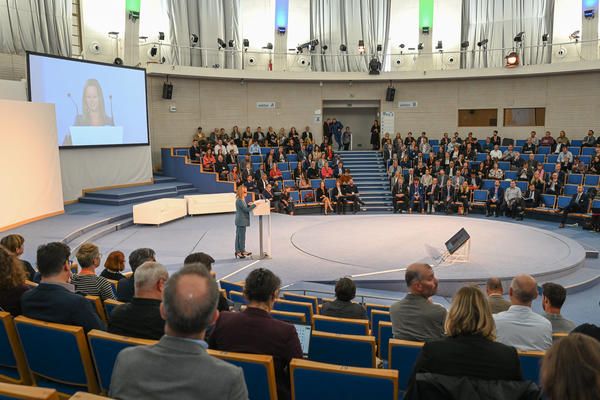
Image from Eltis - The EU Urban Mobility Observatory by © Milan Hruška
Note: this article is ‘unlisted’ on the CIVITAS website, which means it will not appear on the news page or home page.
Several CIVINET secretariats were represented at the Urban Mobility Days 2022 (UMD). We asked those who were able to attend for their impressions of these days, their main takeaways, their lessons learnt, what they would like to see done differently next time, and what they liked the most. Their responses are summarised in the sections that follow.
The main takeaways from UMD 2022
The attending CIVINET representatives were happy to contribute to the CIVITAS 2030 session on the future of CIVITAS, and therefore to be able to provide insights to a wide audience on the CIVINETs’ activities and possible roles. Simply meeting and exchanging with other CIVINETs during this session and during UMD as such was also useful and relevant.
CIVINET representatives also took from UMD that the EU and European cities have many tools to promote sustainable mobility, but too often fail to communicate them properly or to explain the benefits of sustainable mobility to people. Possible solutions discussed include engaging youth, and making tools more useable.
The important role of young academics and students in CIVITAS was made abundantly clear throughout UMD. As one CIVINET reported: as a CIVINET, this will definitely be taken-up in our activities. In addition, UMD discussions re-iterated that all tools and activities should be as simple as possible, and user-friendly for all citizens. Available tools are not always easy to understand and often do not cover all mobility possibilities/issues. Digitalisation is an option to help address this, but certainly not the only option. Furthermore, and regardless of the type of tools developed, data availability is important in order to have good basis for analysis and decision-making processes.
New lessons will be used in daily CIVINET work
CIVINETs will takeaway useful information from European projects (e.g. presented in a session on Sustainable Urban Mobility Indicators), and good practice examples (e.g. those shared in a session on integrated urban planning). The SUMP session was also noted as highly interesting, and discussions on behavioural change emphasised to CIVINETs that behavioural change can be most effective in (primary) schools, because the young population adapts much easier to new sustainable mobility solutions.
Across sessions, interesting and deep theoretical discussions on sustainable urban mobility were often a highlight. The closing plenary enabled youth representatives to synthesise learnings from the UMD, which not only provided interesting observations, but also emphasised the importance of involving younger generations.
Thanks to UMD, the CIVINETs gained new contacts, inspiration, and ideas on topics applicable to their daily work.
UMD emphasised the mobility and climate neutrality is a matter of social impact (social poverty, transport poverty, accessibility for those with disabilities, social acceptance) and gentrification. People with lower incomes often live in European suburbs, from which it is more challenging to reach the city centre for education, work, health services, cultural services, etc.
Looking forward: what to do differently
In general, CIVINETs found that the panel format was overrepresented at UMD. Many of the panel sessions were rather generic, without a lot of concrete and practical information, leading the sessions overall to be too theoretical. While the CIVINET representatives learned that there are a lot of projects working on how to achieve sustainable urban mobility, it would have been interesting to also learn how these projects are implemented in reality. Future events should consider instead emphasising practical examples, or creating sessions specifically for concrete lessons learnt and benchmarks.
UMD and the accompanying Regional City Exchange Workshop (RCEW) emphasised that Brno is a best practice example in public transportation. It would have been very valuable to have a dedicated section or session on this topic led by the City of Brno. The RCEW also examined Brno's experience taking a wider metropolitan view of mobility solutions – more examples of good practices in this area at UMD would have been appreciated.
Small towns and municipalities often do not have the resources to produce urban mobility plans or implement solutions that require huge investments. However, they often find that instead of hi-tech solutions, those that use existing tools and vehicles can do the trick. Further exploration of these ‘simpler’ solutions would be good in the future.
Most enjoyable
The cycling site visit along the river was both useful and enjoyable, while the CIVITAS session with a World Café discussion was the most relevant for the CIVINETs. This session successfully brought forth many good ideas for the future of the CIVITAS and CIVINET networks.
Finally, communication with diverse experts from all over Europe, and gathering ideas and solutions, was very valuable.