36 Cities Paired to Tackle Local Mobility Challenges
Replication & Deployment Programme
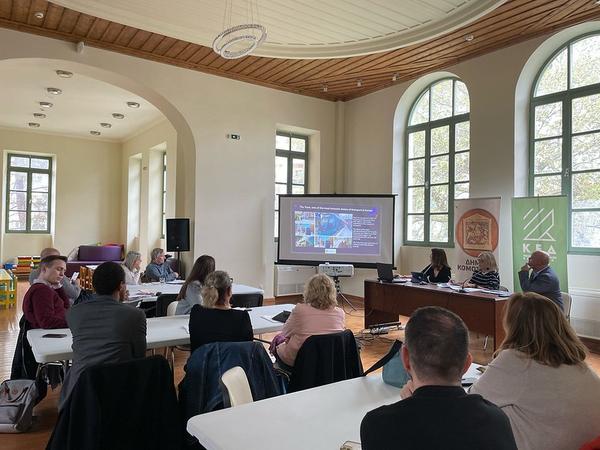
Image by CIVITAS Initiative. Image from CIVITAS Study Visit Komotini April 2025
Cities are rethinking how to move people and goods in ways that are safe, inclusive, and sustainable. Yet too often, innovative solutions remain local experiments rather than becoming widely adopted. The CIVITAS Replication & Deployment Programme is designed to change that.
Through this Programme, cities facing urgent mobility challenges are matched with experienced peers who have already tested successful approaches. The process goes beyond theory: participants learn directly from one another, adapt measures to their own context, and shape detailed roadmaps for implementation.
What sets the Programme apart is its emphasis on peer-learning and collaboration. By bringing together more than 36 cities in structured exchanges, it ensures that practical knowledge, lessons, and tools circulate widely, helping smaller and larger municipalities alike to accelerate their transition towards more sustainable urban mobility.
Pairing Challenge Cities' ambition with Champion Cities' experience
Launched in 2023, the Programme connects cities to tackle specific challenges in sustainable urban mobility. “Challenge Cities”, working to address pressing mobility issues, are paired with “Champion Cities” that bring tested solutions and valuable expertise.
A major milestone has now been reached: the outcomes of the first cycle (October 2023 – August 2025) are available in a brand-new interactive e-publication on the CIVITAS website. This resource brings together the Deployment Plans developed by each Challenge City, including detailed roadmaps that turn local ambition into actionable implementation steps. The publication not only showcases how the cities worked with their peers and experts, but also makes these insights accessible for any European city ready to take inspiration.
Meanwhile, the second cycle (January 2025 – February 2027) is already in full swing. As in the first round, Challenge Cities are paired in twinning pairs and will be matched with Champions based on their complementary needs and strengths, ensuring that knowledge continues to flow where it is most needed.
CIVITAS spoke with Arianna Americo and Anne-Charlotte Trapp of Eurocities, who coordinate these activities. They shared recent developments, what’s new in the second cycle, and what evaluators will be looking for in applications for the newly extended Champion City call.
Thank you to speakers Arianna Americo (Eurocities) & Anne-Charlotte Trapp (Eurocities) for your valued contributions.
In your own words, what is the CIVITAS Replication and Deployment Programme, and what role does it play within the broader CIVITAS initiative?
Arianna Americo:
The Replication and Deployment Programme is essentially a way for cities to learn from each other in a structured and very practical manner.
“Several Challenge Cities have benefitted from tailored support and have now finalised their first Deployment Plans, which is a major step forward in turning ambition into concrete action”.
Where are the results of the first cycle available? What were the main highlights of the first cycle?
Arianna Americo: The results of the first cycle have been brought together in an interactive e-publication, which compiles the Deployment Plans developed by all the Challenge Cities. Each plan sets out a clear roadmap for how the cities intend to implement the measures they worked on during the study visits and workshops, including estimated costs and the key actors to involve.
What really stands out is how practical these outputs are.
“The Deployment Plans don’t just describe ambitions; they lay out step-by-step approaches that other cities can learn from or adapt to their own context”.
Another highlight was the knowledge shared by the Champion Cities and external experts, who brought in tried-and-tested solutions, lessons learned, and concrete advice that helped the Challenge Cities refine their plans.
So, in short, the first cycle demonstrated that this model of peer exchange really works: cities walked away not only with new ideas but also with actionable plans and a much clearer sense of the partnerships and resources needed to make them a reality.
Six Challenge Cities have already been selected for the second cycle. Can you share who they are and what kinds of challenges they’re tackling?
Arianna Americo:
Yes, we’re very pleased with the diversity of the cities involved.
They are working across three main focus areas: road safety and security, behavioural change and mobility management, and mobility hubs.
To give you a flavour, Stuttgart is working on making school zones safer, while Florence is reimagining multimodal connections around Santa Maria Novella Station. In Türkiye, the city of Gaziantep is reinforcing its Sustainable and Smart Mobility Strategy with evidence-based planning and soft measures such as school travel plans and citizen engagement, all aimed at reducing car dependency.
“Each city has identified a specific local challenge that is particularly pressing, but which also resonates with many other European cities facing similar issues”.
What exactly does a Champion City do? And what kinds of cities are you hoping will apply in this second cycle?
Arianna Americo: Champion Cities are those that already have proven experience in sustainable urban mobility. Their role is to support Challenge Cities by sharing what has worked for them, but also by engaging in a genuine peer-to-peer dialogue.
How are Champion Cities matched with Challenge Cities?
Arianna Americo: We carefully review the applications submitted by prospective Champion Cities, paying close attention to the expertise they can offer and the specific challenges identified by the Challenge Cities. The aim is always to create the most meaningful and productive matches.
As part of the process, Champion Cities can also express a preference for which Challenge Cities they would like to support, and we take these into account as much as possible when finalising the pairings. Once matched, the cities embark on a journey of study visits, co-creation workshops, and continuous exchanges to shape tailored solutions together.
The site visits and co-creation workshops are key elements of the take-up and transfer activities. What makes these activities successful in your eyes, and how do they support Challenge Cities in developing a deployment plan?
Anne-Charlotte Trapp: What makes them successful is the very human element. They allow people to share openly and see solutions in practice rather than just on paper.
When Champion Cities visit a Challenge City, they can see how policies or infrastructure work on the ground, speak directly to practitioners, and ask the difficult questions. This combination of trust-building and practical insight often sparks new ideas and helps Challenge Cities refine their Deployment Plans in a way that feels grounded and realistic.
For cities considering applying as Champion Cities, what are you looking for in the applications?
Arianna Americo: We’re looking for concrete, real-world examples of measures that have already been implemented and can be shared with others, in areas of behavioural change, road safety and multimodal hubs.
Strong applications also show a clear motivation to join the Programme, with an open mindset and a willingness to support Challenge Cities in their learning journey.
In the past, some of the standout applications came from cities that not only had innovative projects to share but also showed genuine enthusiasm for collaboration. Cities also get extra points if the solutions they are interested in sharing were developed in the framework of a CIVITAS Project. That combination makes for a very effective Champion.
What are some of the benefits that Champion Cities can expect from participating?
Anne-Charlotte Trapp: There are several. First, it’s an excellent way to boost the visibility of their projects at the European level and to showcase what they’ve achieved.
Second, it’s a great opportunity to strengthen international networks and partnerships. Travel costs for site visits are covered, up to €875, which helps make participation accessible.
But beyond the practicalities, what many Champions value most is the chance to guide other cities while learning in return. For example, during the first cycle, Champion Cities not only shared their experiences but also came back with fresh ideas on how to improve their own mobility policies. This kind of mutual benefit is really at the heart of the Programme.
To apply to become a Challenge City for the second cycle of the Replication & Deployment Programme, fill in this form and send it to arianna [dot] americo [at] eurocities [dot] eu.
Find out more about the CIVITAS Replication and Deployment Programme.
Authors: Arianna Americo, Anne Charlotte Trapp, Robyn Fleming