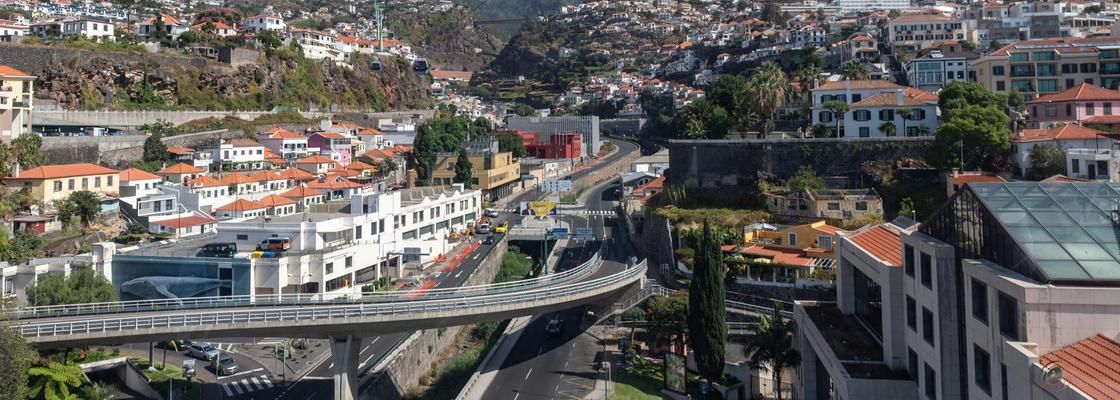
Image from Unsplash
Funchal (Portugal)
Funchal, the capital of Portugal's Autonomous Region of Madeira, is a coastal city nestled between steep hills and the Atlantic Ocean, presenting unique challenges for mobility planning. With a population of approximately 105,782 and covering an area of 76.15 km², its topography necessitates innovative transport solutions.
In 2018, Funchal implemented a Sustainable Urban Mobility Plan (SUMP) focusing on multimodal transport, energy efficiency, and improved logistics. Public transport, managed by Horários do Funchal, is central to the city's mobility strategy, aiming to reduce car dependency and promote sustainable travel. Additionally, regional initiatives like the Sustainable Regional Mobility Plan (SRMP) address tourism-related mobility challenges.
Funchal's commitment to sustainability extends beyond mobility, with efforts in renewable energy, waste management, and biodiversity conservation. These integrated approaches position Funchal as a model for sustainable urban development in island contexts.
Fast Facts
105,782
Population
76 km²
Area
Projects


Knowledge Bank

This is recommended related external content and can be viewed by clicking on it. By clicking you consent to the display of external content. This enables personal data to be transmitted to third-party platforms.
Read more about our privacy policy.
This is recommended related external content and can be viewed by clicking on it. By clicking you consent to the display of external content. This enables personal data to be transmitted to third-party platforms.
Read more about our privacy policy.
News & Events
Awards

Legacy Award